Russian Manicure, Continental Method, or E-File Technique — What Are We Actually Teaching?
You’ve probably seen it on TikTok. Immaculate cuticles. Polish that sits perfectly flush against the skin. Nails that look freshly done three weeks later.
Everyone calls it a Russian manicure. And almost everyone gets the explanation wrong.
It’s Not About Russia. And It’s Not Really About a Technique.
The technique originated in Germany. But the name — that’s a different story entirely.
After the 1917 revolution, the first wave of emigrants from the Russian Empire scattered across the world. During the Imperial era, all its territories — from Kyiv to Tashkent — were “Russian” in the broad sense. People defined their own identity: some felt Russian, others Ukrainian, Jewish, Armenian. But to the outside world, there was one large country with one large name.
The second wave came later — in the 70s, 80s, and 90s, when the Iron Curtain lifted. Nail technicians from Ukraine, Belarus, Moldova, Kazakhstan, Uzbekistan came to the United States and built businesses. They brought e-file techniques with them — selling equipment, working in salons, teaching others.
And when a client asked: “Where are you from?” — the technician would name their small republic within the vast space of the Soviet Union. And see incomprehension on the client’s face. Everyone knew Russia — large, familiar, recognizable. But few had ever heard of the smaller republics that made up the Soviet state. Explaining was difficult — not just because the geography was unfamiliar, but because many technicians didn’t yet speak English well enough to tell the history of an entire country to a stranger in a nail salon. It was easier to say the one big word that the other person would understand.
Client by client. Salon by salon. The technique became “Russian” — not because the technicians called it that, but because it was the only geographic reference that worked in conversation.
One of our clients shared a story that illustrates this more clearly than any explanation. She came to the US in the 80s and for a time worked in a nursing home. There lived a very elderly woman — an emigrant from the first wave, who had left after the 1917 revolution. She spoke about herself simply: “I am Russian. I am from Kyiv.” During the time of the Russian Empire, this was not a contradiction. It was self-definition.
We use the term “Russian manicure” because that’s how clients know it. But the more accurate name is the “Continental Method” — defined by its origin, not its label.
From Pedicure to Manicure
One more nuance worth understanding: European e-file techniques were originally developed **for pedicure**. German podiatry, precision rotary instruments, work on the hardened skin of the feet — that’s where it all began.
It was the technicians from the post-Soviet world who brought e-file technique to the hands. The perfectionism, the attention to detail, the commitment to an ideal result — they transferred the same philosophy to manicure and elevated it to a standard that European tradition had never applied to hands.
So “Russian manicure” as it exists today is a genuinely unique product. Its roots are simply deeper and wider than most people realize.
What Actually Happens During a Russian Manicure
A standard manicure soaks the hands in water, softens the cuticles, and pushes or cuts them back. It works — but it gradually weakens the nail plate, and softened skin tends to grow back faster and less neatly.
A Russian manicure — done correctly — uses no water at all.
Instead, a licensed technician uses a precision electric file (the same family of instruments used in dentistry) to carefully remove dead skin around the nail, refine the cuticle area, and prepare the nail plate for polish or product. Every movement is intentional — minimum contact, maximum precision. The goal isn’t to remove as much as possible. It’s to remove exactly as much as needed.
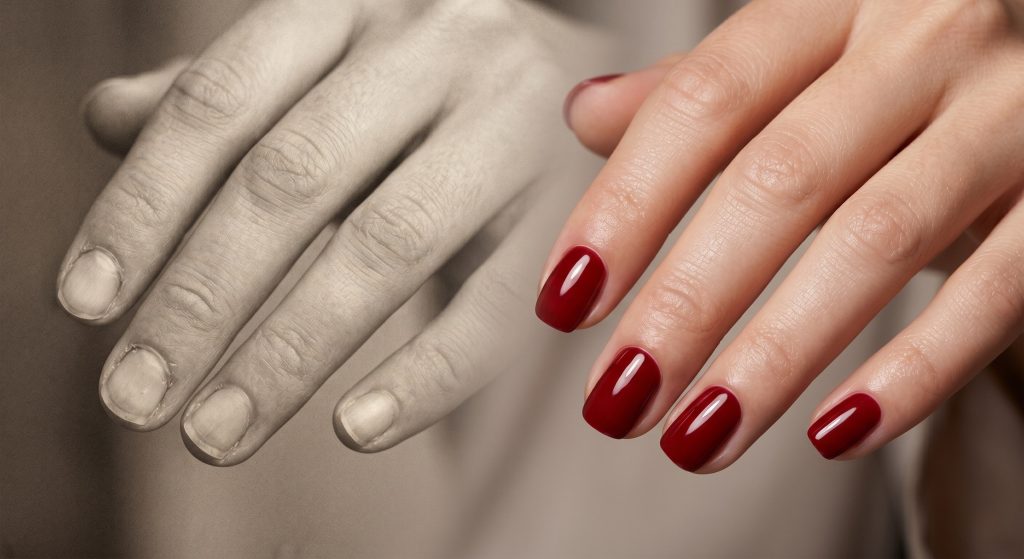
The results speak for themselves:
– Polish sits flush against the skin, with no gap at the base
– The cuticle area stays cleaner, longer
– Results typically last two to three weeks — often longer
– Natural nail health improves over time, rather than declining.
Is It Safe?
When performed by a properly trained, licensed technician: yes. Completely.
The injuries sometimes associated with e-file technique are not caused by the technique itself. They’re caused by the absence of proper training — consumer-grade equipment, unregulated bits, no foundation in classical technique, no supervision.
But there’s another level that rarely gets discussed: understanding skin.
It’s commonly believed that the more aggressively you remove, the more aggressively skin grows back. There’s some truth in that. But only some.
In practice, everything depends on the specific skin and its characteristics. With one client, you can work quite intensively — and the structure of their heels won’t change at all. With another, one unnecessary movement causes thickening immediately. Some clients’ cuticles return as thin, delicate tissue after every treatment. Others have thick, dense cuticles by nature — and working with them is challenging in any technique.
The technician’s job is to recognize, early, what kind of skin and cuticle they’re working with. And to work accordingly.
Not to deliberately create problems — ingrown nails, hyperkeratosis — in order to add extra services later. But to preserve and protect the healthy condition the client came in with.
That is the highest level of professionalism in this work.
Several clients have described Continental Method work as *cuticle surgery* — in the best possible sense. We understand exactly what they mean.
One client moved to us from California. She was referred, came in cautiously — and with an ingrown toenail that had troubled her for years. We resolved it.
When she visited family in California, she’d go to her old technician out of habit. After the first visit back, the ingrown nail returned. We restored it. After the second — again. We restored it again.
“I’m sorry, this is terrible of me,” she said. “But I’ve realized: you fix my problems. He creates them.”
The next time she visited her family, she sent us a message: “I saw my old technician. We caught up. But I didn’t get a pedicure.”
That’s what it means to work for health, not for return visits.
Why Does It Cost More?
Because behind this technique is painstaking practice that most people underestimate.
There’s a common misconception in the nail industry: “I’ll learn Russian manicure and charge more.” That’s true — but it’s only half the truth. The other half is what many prefer not to acknowledge.
Russian manicure is not a set of techniques you can learn over a weekend. It’s a different level of discipline entirely. The assumption “how hard can it be” doesn’t apply here.
The difference between a technician who technically performs e-file work and one who truly masters the Continental Method is roughly the difference between the suture that closes a surgical incision and the work of a plastic surgeon creating a cosmetic result. Both are sewing. But the outcome is different. And what happens to the tissue afterward is different too.
A well-executed Russian manicure requires the technician to understand skin behavior, pressure control, tool angle, and complication prevention at a level most standard cosmetology programs simply don’t teach.
When you pay more for a Russian manicure, you’re paying for that understanding. And for results that prove it.
What to Expect at Your First Appointment
Your first visit will feel different from the beginning. No bowl of water. No soaking. The room is quiet. The work is precise and methodical.
The first appointment may be noticeably better than what you’ve experienced in standard salons. But real results take time. The technician needs to understand your skin, observe how it responds, and calibrate their approach specifically to you.
By the fifth or sixth visit, clients typically notice it themselves: the shape of their nails has changed, the free edge is longer, the nail under the product is healthier. That’s not the technique. That’s time and the right work.
*More on this in the next article.*
Nail Evolution PRO is downtown Camas’s only studio offering authentic Continental e-file technique. Founded by Irina Anderson — licensed nail instructor, MBFW manicurist, 4th place at the NAILPRO World Cup, nearly 20 years of experience and international training.
*By appointment only.