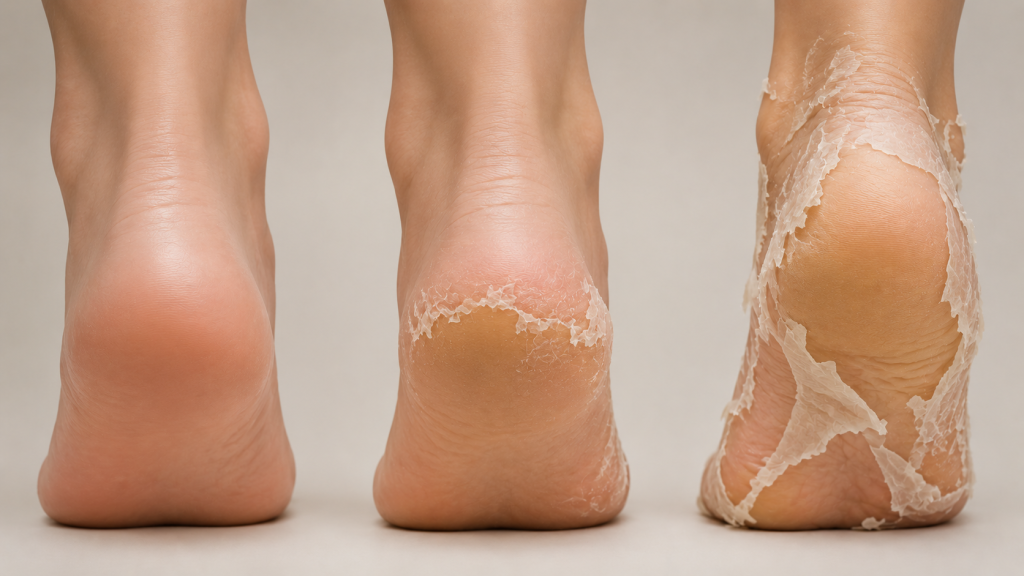
Clients buy them at the supermarket, wear them for an hour, wait a week — and then can’t stop the peeling for weeks. And at the next pedicure, the skin turns out to be denser than it was before. Here’s why.
A familiar pattern
Over years of practice, I kept seeing the same thing in clients: after foot peel socks, the skin sheds heavily and for far longer than promised — sometimes for months. It comes away in ragged sheets, still partly attached to the living layer underneath: too painful to pull off, too raw to file. Then, months later, or even years, the heels return dense, yellowish, and almost completely resistant to files, pumice, or apparatus. Among technicians, we call it the “rubber heel.” Most clients had never connected the two — the gap in time is too long. But the pattern is unmistakable, and one use is often enough.
What’s actually inside the sock
The packaging says “natural extracts” and “fruit acids.” In reality, sealed inside that plastic sock is a multi-level chemical peel: alcohol-based penetration enhancers, an alkali (KOH), four AHA acids at once, and salicylic acid — all under occlusion, applied to the entire sole at once, including the thin skin of the arch. The recommended time varies from brand to brand, but it’s usually 10–30 minutes. The problem is that people want the product to “give the skin everything it’s got” and slough off as much as possible — so many leave it on for an hour. Or longer.
“It’s weird that the company doesn’t tell you what percent of glycolic acid is in the product.”
— Sandra Bendeck, MD, dermatologist. [1]
No major brand discloses the concentration of its actives. [1] And crucially, there is no neutralisation step. In a professional peel, the technician stops the reaction with an alkaline solution at exactly the right moment. In a sock, nothing tells the acids to stop — so they keep working the whole time the sock is on, going progressively deeper. And it’s rarely the prescribed time: people get absorbed in a film and forget, or put the socks on at night and drift off in them.
Where the “rubber heel” comes from
When peeling lasts weeks rather than days, it means the living layers of the skin were reached — not just the dead stratum corneum.
“Too much exfoliation can lead to thinning of the skin, dryness, rash and cracks in the skin.”
— Malini Fowler, MD, FAAD, dermatologist. [2]
After that, the skin defends itself: the basal layer reads it as serious damage and speeds up cell division. Immature cells reach the surface with incompletely formed intercellular layers [3], while the mechanical load on the foot hasn’t gone anywhere. The result is a dense, uniform stratum corneum with no normal layered architecture. A file works along those layers — and there are none left. That’s why the tool “won’t move” the skin, and pressing harder is pointless: it’s simply a different skin structure.
What to do
If it’s already happened — don’t try to file it down harder, and don’t repeat the socks thinking “one more peel will reset it.” Both responses only intensify the thickening. Go to a specialist or podiatrist, and bring the skin as it is — don’t “prepare” it at home first. Your job is to show the problem in its raw form, not your own attempts to fix it; otherwise the picture gets blurred and the professional may see something that isn’t there. Recovery is a series of progressive professional treatments, not a single one.
As for home care: healthy skin needs moisturising, and a basic professional foot cream handles that perfectly well — that’s enough. Keratolytics — urea at 10% and above — are appropriate only when there’s hyperkeratosis: rough, dense skin prone to calluses, and on the recommendation of your technician or doctor. There’s no need to soften skin that has nothing to soften. By necessity, not by desire.
So are foot peel socks always bad?
No. The original Japanese formula earned its reputation precisely through predictability. The problem is the dozens of copies with unknown concentrations and unbalanced formulas: you can’t tell them apart from the outside, and the consequences show up not the next day but months later — long after the connection has been forgotten.
Want to understand the chemistry more deeply? How urea, acids, and alkalis actually work, which concentrations are safe at home and which belong only in the treatment room, and a full protocol for working with already-damaged skin — all in our keratolytics lesson.
Sources
- “Is Baby Foot Safe?” — One Medical. Quote by dermatologist Sandra Bendeck, MD; also the point that AHA is generally regarded as safe below 10% while the product does not disclose its concentration. onemedical.com/blog
- “Foot peels: Experts weigh in on whether they’re safe” — Scripps News (e.g., kxxv.com). Quote by dermatologist Malini Fowler, MD, FAAD, Westlake Dermatology.
- On the skin’s compensatory response — barrier disruption driving basal-layer hyperproliferation, and accelerated, incomplete keratinisation yielding immature corneocytes: J.A. Segre, “Epidermal barrier formation and recovery in skin disorders,” J Clin Invest (2006); Elias/Feingold barrier-homeostasis studies (e.g., “Barrier function regulates epidermal DNA synthesis,” J Invest Dermatol); and on parakeratosis (accelerated, incomplete keratinisation), “Key Factors in… Skin Keratinization,” Int J Mol Sci (2024). Note: “rubber heel” is a practitioners’ term; the mechanism described is consistent with established skin-barrier biology rather than a single named study of this specific outcome.