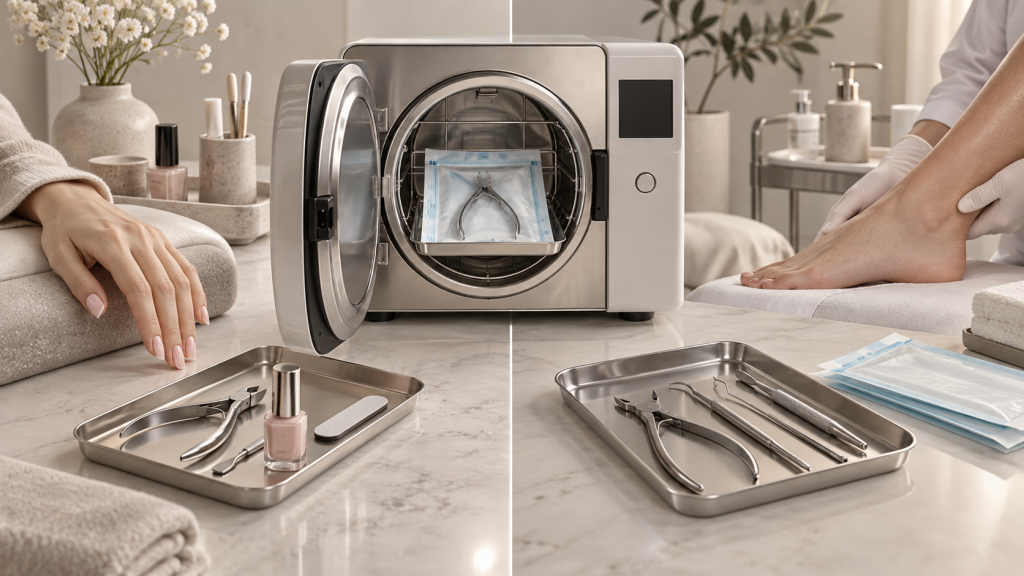
Where the salon autoclave came from, and why a rule rarely travels well without its reason.
If an American nail tech scrolls through the feeds of Russian-speaking colleagues, one thing stands out fairly quickly. Almost everyone owns an autoclave, and almost everyone shows it. Not in passing — as its own shot: the chamber, the indicator, the sealed pouch with the date written on it. A piece of equipment that most US states don’t require for nail services at all has become, in our world, a point of pride and an argument in itself.
The explanation that comes to mind first — that one group simply cares more — is the wrong one. The answer isn’t about conscientiousness. It’s about where each country draws the line around the profession.
Let me start with what I watched happen.
In Russia, manicure and pedicure live in the same salon. Often with the same tech, frequently in the same room, sometimes at the same table half an hour apart. That is normal there, and nobody treats it as a problem.
Then, at some point, people with medical training moved into pedicure. Nurses — arriving with the habit of protocol already formed: sterilization, single use, instruments handled the way they are handled in a hospital. They also began taking on the work a person should properly bring to a doctor: fungus, ingrown nails, inflammation, the diabetic foot. The service was given a name borrowed from Germany — podology — where that word stands for a medical specialty with its own training and a state exam behind it. In Russia, there is still no separate license for it.
The requirements followed. Not because someone at the top decided so, but because one profession moved into another and brought its rules along with it. First came work that borders on medicine, then the people who knew how to handle it, and only after that the strictness everyone now assumes was there from the beginning.
That strictness has exactly one logic behind it, and it is a sound one: what the tech meets on a foot must never end up on the hands of the next client. That is cross-contamination, and when hands and feet are served in one room by one pair of hands, the risk stops being theoretical.
Here, things are built differently — and the difference is not in how much anyone cares. It is in where the line sits.
A foot with a pathology goes to a podiatrist. That is a physician, with a license, an education and an office of their own. A nail tech does not take that work — not out of reluctance, but because it falls outside their scope of practice, and that is written into state rules. A different body of work comes to the salon, and the requirements written for it are different too: clean instruments, disinfection — and for nail services, most states do not call for an autoclave at all.
Neither system is the wrong one. They describe different conditions. In one, the boundary between cosmetics and medicine is blurred, and equipment has to make up the difference. In the other, the boundary is drawn by licensing, and there is nothing to make up.
But the conclusion here is not “relax, we have it easier.” It is more interesting than that, and it concerns everyone.
If a job calls for an autoclave, then medicine is standing next to that job. And if medicine is standing next to it, then in this country it has its own practitioner and its own license. Which means the tech who decides to treat a client’s foot a little — bring down the inflammation, deal with the ingrown nail, take a look at that fungus — is moving in exactly the opposite direction: out of cosmetics and into medicine, without the training and without the right to it.
Usually that tech does not think of it as a violation. They think they are doing more than required, that they are taking care of someone, that it is easier for the client this way. But the crossover runs in both directions: just as instruments carry what they should not, professions hand each other work they are not prepared for. And the first thing to give it away is the equipment. Tools are more honest than we are — they show what work we are actually doing.
And here is the last part, which is why I have told any of this.
We work in a profession where rules arrive from everywhere: from another country, from someone else’s textbook, from a video by a tech you trust. And they almost always arrive with no account of where they came from.
An autoclave in the frame is a rule without its context. We do not know what stands behind it, but we read it as extra care for the client, as a level of cleanliness above the ordinary. It does have specific answers to “what for” and “why” — and under different conditions it can mean something quite different from what the tech assumed. Nearly every rule we repeat after someone else works the same way: it had a reason, and the reason did not travel with it.
So the one skill that genuinely helps here is the habit of asking not “is this right or wrong,” but “where did this rule come from, and what was it meant to solve.” The answer almost always explains both the rule itself and whether it applies to you. And whether you need it.