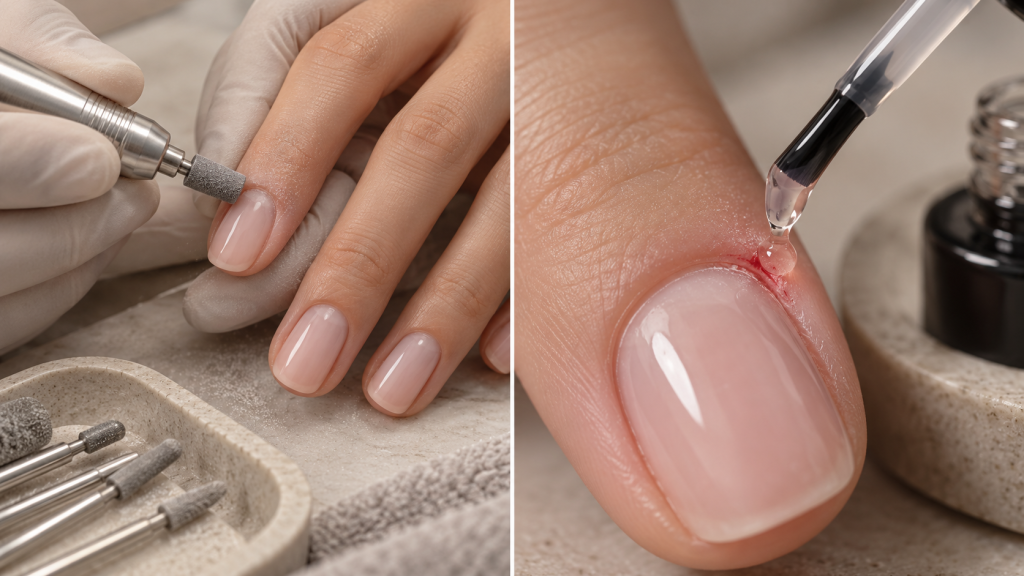
It has become popular in American feeds to post “proof” that Russian manicure is dangerous. The photos show burns, lifted nail plates, allergic reactions, and sometimes conditions that have nothing to do with a manicure at all, like psoriasis. The caption is always the same: this is what an e-file near the cuticle does.
We won’t argue that bad work exists. It does — with any technique and under any name. But these posts have one odd thing in common. They say “A” — over-filing is dangerous — and never say “B.” And “B” matters far more.
An over-filed nail fold on its own is an injury that will heal. The real danger starts a second later, when product goes on the nail: gel polish, hard gel, acrylic — any nail product based on acrylates.
What actually happens
Skin protects us not only from microbes but from chemicals. The stratum corneum — the same non-living top layer we remove from the nail fold — holds back substances that land on the surface. As long as it is intact, a stray drop of gel on the skin is not yet a disaster, provided it is removed right away.
Now picture a nail fold filed down to living tissue. Or a sidewall with a nick in it. Or a fresh edge left by a careless cut — with nippers, scissors or a bit, it makes no difference. The protective layer is gone. And this is exactly where, a few millimeters from the wound, the technician goes on to apply base, color and top coat.
Uncured gel and monomer are mixtures of acrylates, and they are called sensitizers for a reason. The UK’s National Eczema Society says it plainly: uncured monomers can easily penetrate a broken cuticle, nail fold or damaged skin barrier. A wound is an open door, and the chemistry walks right through it.
So we have a combination of two parts: damaged skin plus product. Each one on its own is manageable. Together they make the shortest path to allergy there is in our work.
Why it’s forever
Over-filing heals in a few days. A heat spike in the lamp passes. Irritation from acetone fades once contact stops. An acrylate allergy does not go away. The immune system remembers the substance, and from then on every new contact triggers a reaction.
And it’s not only about manicures. Acrylates are found in dental fillings, in the bone cement used to fix joint replacements, in medical adhesives. The same National Eczema Society warns that allergy to these chemicals can have lifelong consequences — to the point that a person has to avoid dental treatments and surgeries that involve acrylates.
So the price of one careless manicure is not lifted gel or two days of a sore nail fold. It can be a person who, ten years later, can’t get an ordinary filling. And this applies not only to clients but to technicians: hundreds of nail professionals leave the industry because of an allergy they built up in themselves without noticing, one drop at a time.
Why nobody talks about “B”
Because “B” is inconvenient. It applies to everyone. A nail fold can be damaged with a bit, with nippers, with an overzealous pusher — whatever the technique is called. And the gel that ends up in that wound can be any brand. Which means the problem is not the method but a specific action by the technician: injuring the skin and putting product on it.
That doesn’t sell. It’s much easier to say: “This technique is dangerous, look at these allergy photos — but mine is safe.” Say “A” — over-filing is dangerous. And stay silent about “B” — the mechanism that works in any technique, including your own.
When facts are swapped for the sake of sales, or for the sake of an argument about names, it isn’t the competitor who suffers. It’s the client, who was never taught how to protect themselves. And the technician who believed that switching techniques is enough to avoid allergy. For a professional, swapping facts is as low as it gets.
What we do
Our goal is not to win an argument about a name but to cover both points: “A” and “B.”
- The boundary is dry skin. The e-file and the blade work only on keratinized tissue. We don’t go into living skin — not with a bit, not with nippers.
- Tools that don’t tear the skin. Dental bits with quality finishing, the right RPM, light pressure. A cheap bit from a marketplace isn’t a savings — it’s a risk.
- Product never touches the skin. Not the base, not the gel, not the top coat goes onto the nail fold. Flooding is removed before the lamp, not after. Many techs don’t like this: it takes time, and it’s easier to cure it and file the flooded product off with the e-file later. But if your hand isn’t steady yet, that is a direct path to filing quite deep — and both the sticky layer and the filing dust are guaranteed to end up in that wound. One more thing: if the flooding is bigger than a dot, don’t try to “save” the coat. A large flood is hard to remove — it spreads more and more, and the contact time with the tissue only grows. Take it all off with alcohol, let it dry and apply again.
- Complete cure. A lamp matched to the product, thin layers, honest curing time. Undercured gel means free monomer on the nail and around it.
- A fresh wound means no coating. If the skin does get damaged, we don’t apply product to that finger that day. Better to reschedule one nail than to give a client a lifelong allergy. And if you don’t yet feel confident and steady in your hands — move the coating to the next day: manicure today, product tomorrow. Skill level decides everything here. An experienced hand works without wounds and calmly does it all in one visit. Someone who is still developing their hand protects the client with time — and that isn’t weakness, it’s an honest assessment of your own hands.
- The technician protects herself, too. No skin contact with uncured product, no “wiping it off with a finger,” a clean workstation. About gloves: the ones sold in professional beauty supply stores are usually thinner than 4 mil, and finding thick enough ones is a real problem. On top of that, they need to be changed every half hour — that’s three or four pairs per service. To what end? The main goal is to avoid contact with the product. And it’s precisely without gloves that a technician will feel that contact the moment it happens. So we put our bet on the cleanliness of the work itself. And make it a rule: after every service, thoroughly wipe down with alcohol everything you worked with and touched — brushes, jars, surfaces and your own hands. Only then wash your hands with soap, and if your skin tends to get dry, apply a hand cream.
A little from the old school
Back when sculpting was taught, schools warned from the very first day: there must be no contact between product and skin at all. It was the foundation of the foundations. More than that — with enhancements, clients were advised to come back for the manicure the next day, so that freshly cut skin and product would never meet in the same visit.
Clients found this unacceptable: two appointments in a row. So did technicians — who wants to spend two days of their time on one client? Then schools decided to teach “without the fluff,” and companies and their ambassadors declared nail products completely safe. We once heard that one company’s monomer was so safe you could literally… lick the brush! And all of this important theory simply disappeared.
That is exactly what makes technicians and clients treat professional products so recklessly: sculpting nails practically with their bare hands, flooding not only the nails but the cuticle with monomers and gels — and considering it normal.
Let’s be honest: “B” is far more serious than “A.” Yet all the blame landed on “A.” Anyone even slightly familiar with the rules of marketing will recognize the move instantly: to sell your own thing, you need an enemy — a convenient one, with someone else’s name on it. And wherever one thing is loudly condemned while another is carefully left unsaid, there is always a swap of facts behind it. Keep that in mind — and the next time you hear “A,” ask about “B.”
We’re not suggesting bringing back two visits. But the theory is worth bringing back.
And most importantly, we say this to clients and colleagues directly. The danger isn’t in the e-file or in the name of a technique. The danger is gel that gets into a wound.
Sources
- National Eczema Society — Nail allergy and eczema: “any uncured monomers can easily penetrate the broken cuticle, nail fold or damaged skin barrier”; “allergy to these chemicals can have lifelong consequences,” including “avoiding future dental treatments and surgeries containing acrylates.”
- British Association of Dermatologists, press release, August 9, 2018: “(Meth)acrylates should be kept away from all direct skin contact”; allergy has “lifelong consequences for dental treatments and surgeries.”
- CTPA, Guideline on Artificially Enhanced Nails, 2023: “Safe use requires that the acrylic system or gel system is not allowed to contact any part of the skin” (§4.1); do not apply if the skin around the nail is sore, inflamed or broken (§4.2).
- Kalenge et al., Annals of Work Exposures and Health, 2021: acrylates found on salon surfaces contaminated with product.
- Doug Schoon, Nail Structure and Product Chemistry, ch. 8, pp. 239–240: monomers, incomplete cure, residual allergens.